Get a Quote
← All Products
Home / Products / STP & ETP media
Application guide

Water Treatment Media
for STP & ETP

Which media belongs at which stage of a sewage or effluent treatment plant — from inlet desanding through biological treatment to tertiary filtration and the air system that ties it together.

SedimentationBiologicalAerationFiltration
Water treatment media for STP and ETP plants
Settling boost
3 – 5×
Biofilm carrier
>600 – 1300 m²/m³
Filter surface
3000 m²/m³
Filtration rate
20 – 85 m/h
Carrier life
>15 years
Treatment train

Where each product sits in the process

A treatment plant is a sequence, and each stage has a media or equipment decision attached to it. This is the order we normally work through with a project.

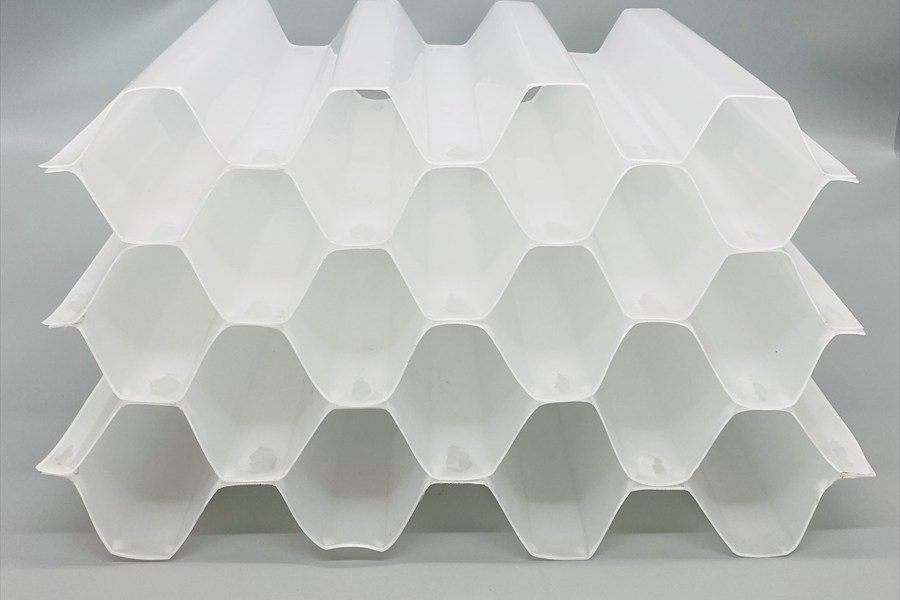
1. Inlet / grit & desandingTube settler media — hexagonal or lamella inclined tubes for inlet desanding and solids removal. Published handling is 3–5× a flat basin at a hydraulic load of 3–5 t/m²·h.
2. Primary / secondary clarificationTube settler media or inclined plate (lamella) media — increases effective settling area inside an existing tank footprint. Φ25–90 mm in PP, FRP or stainless steel, installed at 60°.
3. Biological treatmentMBBR media (K1–K5, PE01–PE08) for attached-growth duty, or suspended ball media (Φ55–150 mm) where a free-moving porous carrier suits the tank. Surface area from >600 to >1,300 m²/m³.
4. Aeration of the biological stageDisc aerators in 215 / 260 / 300 mm, EPDM or silicone membrane, for aerobic tanks and aerated biofilters.
5. Tertiary / polishing filtrationFiber ball filter media — Φ25–80 mm, 3000 m²/m³ specific surface, 96% porosity, filtration rate 20–85 m/h, dirt-holding capacity 6–10 kg/m³.
6. Air and dosing pipeworkABS pipe and fittings — solvent-cement or push-fit jointing, used for aeration and air-header piping, sampling lines and chemical dosing. Flame-retardant ABS in DN20 is available where the electrical or fire specification requires it.
STP vs ETP

What changes between a sewage and an effluent plant

The equipment list is broadly similar; the selection criteria are not. Getting this wrong is the most common reason a design underperforms.

01

Sewage (STP): flow-driven

Municipal and domestic sewage is relatively consistent. Design is dominated by hydraulic load and the settling area needed, which is why tube settler and lamella media do so much of the work in the clarification stages.

02

Effluent (ETP): load-driven

Industrial effluent varies by sector — textile, chemical, food, pharmaceutical, metallurgy. Design is dominated by the pollutant load to be removed, so carrier selection in the biological stage matters far more than in a domestic plant.

03

Solids character drives pore size

Fibrous or oily industrial loads blind small pores quickly. That is why ETP projects more often sit at the larger end of the pore range (Φ50–90 mm) while domestic plants can use smaller pores for the extra surface area.

04

Chemicals change the material

PP suits general duty; FRP gives the highest surface area; stainless steel is built to order for high temperature or aggressive chemistry. In ETP work the material of construction is a chemistry question, not a cost question.

The real market

Retrofit and upgrade work

Tighter limits are what drive most retrofits. See the discharge standards guide for how a permit maps to a media specification.

Most plants we supply are not new builds. They are existing tanks that have to meet a tighter discharge standard without a bigger footprint — and that is where media rebuilds earn their place.

01

Standards keep tightening

Across Southeast Asia and South Asia, discharge regulations have been consolidated and tightened in recent years. Vietnam, for example, replaced eleven separate industrial wastewater standards with a single one effective 1 September 2025. Plants built to older limits generally have a transition period — and then have to comply.

02

Capacity without civil work

Adding inclined media to an existing clarifier increases effective settling area without pouring concrete. That is normally the cheapest route to a higher hydraulic load on a fixed tank.

03

Fixed film over activated sludge

Upgrading an aeration tank with MBBR carriers raises the biomass inventory without expanding the tank — the published dosing window is 15–67% of reactor volume, so the retrofit is designed rather than simply filled.

04

Media is a wear item

Filter media and membranes are consumables. Fiber ball media is quoted at roughly 1 year for standard grade and about 2 years for the modified grade; diffuser membranes harden and foul over time. Replacing them is a recurring order, not a one-off.

Common questions

STP & ETP media questions

Q1

Which media should I start with?

Start with the stage that is failing. If the clarifier is the bottleneck, inclined media is usually the answer; if the biological stage cannot hold enough biomass, it is a carrier question; if the final effluent is turbid, look at filtration. Supplying a whole train at once is only sensible on a new build.

Q2

Can I upgrade an existing plant without new civil works?

That is the usual case. Inclined media in existing clarifiers and MBBR carriers in existing aeration tanks both increase capacity within the same footprint. What limits it is the tank geometry and, for MBBR, whether the existing aeration can fluidise the bed.

Q3

How much does a media upgrade cost?

On request. It depends on material, pore size or carrier model, the volume required, export packing and destination port. Send the tank dimensions and the target effluent and we will quote against a checked quantity.

Q4

Do you supply complete plants?

No — we manufacture media and aeration equipment. We supply the media, carriers, diffusers and piping that EPC contractors and plant operators specify, and we are happy to work directly with your designer on the specification.

Q5

What information do you need to quote?

Flow rate (peak), tank or reactor dimensions, influent and target effluent figures, the discharge standard you are working to, and the destination port. With those we can confirm the media, the quantity and the export packing.

Q6

Can you supply against a project specification?

Yes. Send the specification or bill of quantities and we will confirm compliance item by item, or state plainly where our published figures differ from what is specified.
Products in this guide

Go straight to the product

Tell us your application or standard

Send your water quality, treatment scale and target standard - we will confirm the right media, quantity and export packing.

Request a QuoteNo obligation - response within 24h (working days)