Get a Quote
← Tube Settler Media
Home / Products / Tube Settler Media / Sizing guide
Engineering guide

Tube Settler Media
Sizing & Specification

How to calculate the settling area and media volume you need, why the installation angle matters, and how to specify PP, FRP or stainless steel for your tank — using the parameters we actually publish on the product page.

60° installation angleV₀ 2.5–3.0 mm/s3–5 t/m²·h hydraulic load
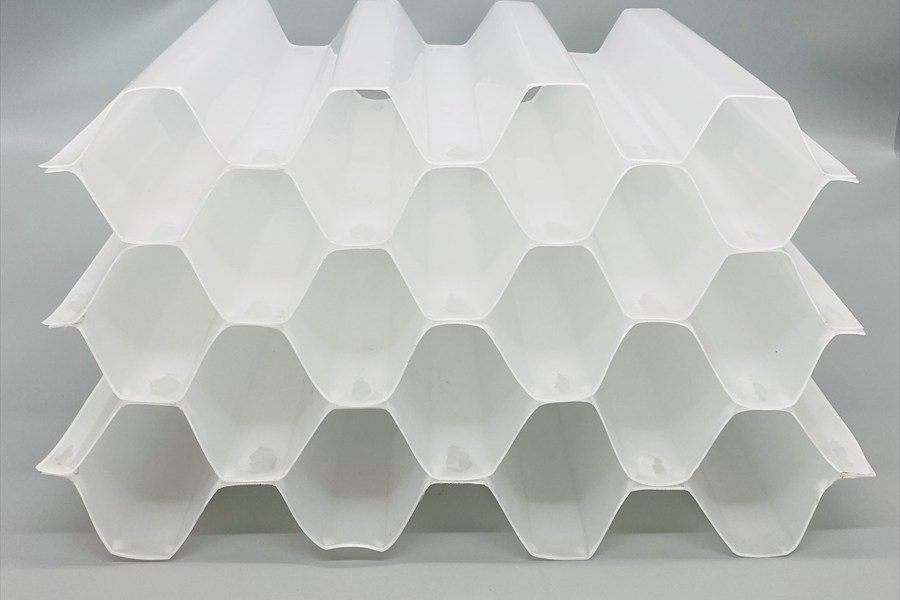
Hexagonal honeycomb tube settler media module
Pore sizes
Φ25–90 mm
Module size
1000×500×1000
Stack height
4 – 5 m
Surface area
62–236 m²/m³
Porosity
93–97%
Step 1 — sizing

Prefer to run the numbers yourself? Use the online tube settler media calculator.

How to calculate the tube settler area you need

Tube settler media is sized on surface loading rate, not on tank volume. Get the settling area right and the rest of the design follows.

01

Start from the design flow

Take the peak hydraulic flow through the clarifier, in m³/h. Use peak flow, not average — tube settlers are most often undersized because the design was based on daily average.

02

Pick a surface loading rate

For tube settler media we publish a hydraulic load of 3–5 t/m²·h (equivalent to 3–5 m³/m²·h). Fast-settling mineral solids suit the higher end; light biological floc needs the lower end.

03

Divide flow by loading rate

Required settling area A = Q ÷ SLR. A 100 m³/h flow at 4 m³/m²·h needs about 25 m² of projected settling area.

Design flow Q100 m³/h (peak)
Surface loading rate SLR4 m³/m²·h
Required settling area A = Q ÷ SLR25 m²
Stack height4.5 m
Indicative media volume A × height≈ 112 m³
Check: velocity inside the tubes2.5 – 3.0 mm/s (design V₀)

Media volume is normally quoted in m³, so the final figure you send to a supplier is the volume plus the pore size and material. The exact module count depends on the installed footprint and how the modules are cut around weirs and launders — that is confirmed per project rather than assumed from a catalogue.

Step 2 — angle

Why tube settler media is installed at 60°

The installation angle is the single most common specification question from engineers in the UK and Europe, and it is not a free choice.

01

60° is the published installation angle

Our modules are installed at 60° from horizontal. Steeper angles cost effective settling area; shallower angles stop sludge sliding down the tube wall.

02

Sludge must slide, not stick

The tube wall has to be steep enough that settled solids keep moving back down to the sludge zone. If they stall, the tube blocks and the module has to be taken out and washed.

03

Angle sets the projected area

Because the modules are inclined, the projected settling area you gain is not the same as the module's physical footprint. This is why the calculation above works in settling area first, and converts to media volume second.

Step 3 — material

Choosing between PP, FRP and stainless steel

Material of construction (MOC) decides both the chemical duty and the service life. All three options below are published specifications.

MaterialPore sizesThicknessSurface areaPorosityDensity
PP (polypropylene)Φ25 / 35 / 50 / 800.5 – 0.8 mm62 – 200 m²/m³93 – 97%22.8 – 46 kg/m³
FRP (glass fibre)Φ25 – 600.5 mm99 – 236 m²/m³93 – 97%42 – 95 kg/m³
Stainless steel (custom)Φ25 / 35 / 50 / 60 / 80 / 900.5 – 0.8 mm62 – 236 m²/m³93 – 97%On request
PP

General municipal and industrial duty

The default choice. Service life is published as PP 3–4 years; co-polymer based media can extend that to 8–10 years in water.

FRP

Highest surface area per m³

Up to 236 m²/m³, so it packs more settling surface into the same tank volume when space is the constraint.

SS

High temperature or aggressive duty

Stainless steel modules are built to order and go up to Φ90 mm. Density is quoted On request because it depends on the grade and wall thickness specified.

Φ25 mmΦ35 mmΦ50 mmΦ60 mmΦ80 mmΦ90 mm
Step 4 — installation

Installation and stack height

Tube settler modules are stacked to a published height and then fixed so they cannot float, shift or short-circuit.

01

Stack height 4 – 5 m

Modules are stacked to a total height of 4–5 m. Below that the settling benefit drops away; above it the head loss and the support structure cost both rise.

02

Support and restraint

Modules sit on a support frame and are restrained from above. Empty PP modules are light (22.8–46 kg/m³), so uplift and movement in a draining tank are a real failure mode if they are not tied down.

03

Retrofit into an existing tank

The most common use is not a new clarifier — it is an existing tank that needs more capacity without a bigger footprint. Modules are cut to suit the existing weirs, launders and sludge scrapers.

Performance

What the media delivers once sized correctly

These are the published figures for our tube settler media — useful as a sanity check when you compare quotations.

Handling capacity vs a flat basin3 – 5×
Handling capacity vs a shallow tank2 – 3×
COD removal85 – 90%
Organic load2000 – 5000 g/m³·d
Design velocity V₀2.5 – 3.0 mm/s
Hydraulic load3 – 5 t/m²·h
Service lifePP 3–4 yrs; co-polymer up to 8–10 yrs
SKU / priceNWS-HXT series · On request
FAQ

Sizing questions we are asked most

Q1

What pore size should I choose?

Pore size trades surface area against blocking risk. Smaller pores (Φ25–35 mm) give more surface area per m³ and better removal of fine solids, but block sooner with fibrous or oily loads. Larger pores (Φ50–90 mm) stay clean longer and suit high-solids or desanding duty. Tell us your solids type and we will confirm the pore size.

Q2

How much media do I need in cubic metres?

Work out the settling area from your flow and surface loading rate (Step 1), then multiply by the stack height. Send us the flow rate, tank dimensions and target solids, and we will return a checked quantity.

Q3

Can I mix materials in one tank?

Yes — it is common to use one material where the duty is aggressive and another elsewhere. Because modules have to be cut to the same stack height, it is worth fixing the material schedule before the tank is measured.

Q4

Why is the price On request?

Price depends on material, pore size, sheet thickness, total volume, packaging and destination port. Because those vary per project we confirm the specification first and quote against it rather than publishing a list price that would not apply to your case.

Q5

How does it compare with inclined plate media?

Both are inclined settling media. Tube settler media uses hexagonal tubes; lamella plate media uses flat plates. The choice usually comes down to the duty and what the tank can accept. See the inclined plate media page for the plate version.

Q6

Which industries use it?

Municipal wastewater, industrial effluent, inlet desanding, oil separation, tailings thickening and old-tank retrofits. See the product page for the full application list.
Related

Continue from here