Enter your peak flow, surface loading rate and stack height to get the settling area and media volume you need. The arithmetic runs in your browser — nothing is sent anywhere.

Use peak hydraulic flow, not daily average — sizing on average flow is the most common cause of an undersized clarifier.
| published range 3–5 | |
| published range 4–5 |
Note on the result: this gives the settling area and the media volume in m³ — the unit media is quoted in. The final module count depends on the installed footprint and how modules are cut around weirs and launders, so it is confirmed per project rather than assumed from a catalogue. Send us the numbers and we will check them.
| Step 1 | Required settling area A = Q ÷ SLR. For 100 m³/h at 4 m³/m²·h, A = 25 m². |
| Step 2 | Media volume = A × stack height. At 4.5 m, volume = 112.5 m³. |
| Step 3 | Sanity-check the velocity inside the tubes against the published design figure of 2.5–3.0 mm/s. If your calculated loading rate implies a velocity well outside that, revisit the loading rate input. |
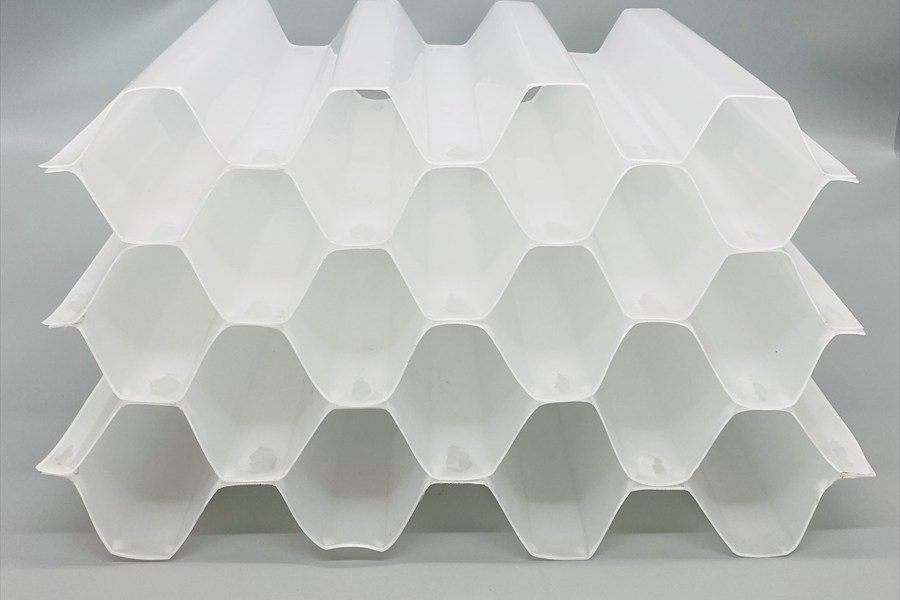
| Why it works this way | Tube settler media gives each particle a short settling distance to the nearest inclined surface instead of the full tank depth. Because the surfaces are inclined at 60°, the settling area gained is larger than the module footprint — which is why you calculate area first and convert to volume second. |
Our published hydraulic load for tube settler media is 3–5 t/m²·h, equivalent to 3–5 m³/m²·h. Fast-settling mineral solids suit the higher end; light biological floc needs the lower end. If you are unsure, calculate both ends of the range to see how much tank area the choice implies.
Published stack height is 4–5 m. Below that the settling benefit drops away; above it, head loss and support structure cost both rise. The default of 4.5 m is a reasonable mid-point for a first estimate.
Use the highest sustained flow the clarifier will see. Plants sized on daily average routinely pass commissioning and then fail under real load.
The volume is the start of the specification, not the end of it.
| Pore size | Φ25–90 mm depending on material. Smaller pores give more surface area per m³ and capture finer solids, but blind sooner on fibrous or oily loads. |
| Material | PP for general municipal and industrial duty; FRP where the highest surface area per m³ is needed in a fixed footprint; stainless steel for high temperature or aggressive chemistry. |
| Panel/module size | 1000 × 500 × 1000 mm as standard; cut to suit existing weirs, launders and scrapers on a retrofit. |
| Service life | PP 3–4 years; E-P co-polymer 8–10 years in water. |
| Price | On request — confirm pore size, material, volume and destination port. |
No. The calculation runs entirely in your browser. Nothing you type is transmitted, stored or logged — you can disconnect from the network and it still works.
Because media is quoted in m³, and the module count depends on the installed footprint and on how modules are cut around weirs and launders. Those are project-specific, so the volume is the honest number to start from.
Check the loading rate first. A rate at the very bottom of the range produces a very large area, and one above the published range produces an area that will not perform. The published range is 3–5 t/m²·h.
The sizing logic is the same — see the tube settler vs lamella comparison for where the two products differ and which suits your tank.
Yes. Send the flow rate, the loading rate you used, tank dimensions and target solids, and we will confirm the area and volume and quote against a checked specification.
The MBBR equivalent is calculated from pollutant load rather than hydraulic flow. See the MBBR media calculation guide for the formula and a full worked example.
Send us the flow rate, loading rate and tank dimensions - we will confirm the area, volume and specification.
Request a QuoteNo obligation - response within 24h (working days)