Both are inclined settling media and both raise the effective settling area inside a tank you already have. The difference is geometry — hexagonal tubes versus flat plates — and it changes the installation angle, the blocking risk and how the modules are built.

Both products exploit the same physics, so it is worth stating plainly before comparing them.
A particle only has to fall the short distance to the nearest inclined surface, not the full depth of the tank. That is why inclined media achieves a far higher hydraulic load than a flat basin for the same footprint.
Once settled, solids slide down the incline and return to the sludge zone. The angle has to be steep enough for that to keep happening — if it stalls, the media blocks.
Because the surfaces are inclined, the settling area you gain exceeds the module's physical footprint. This is why sizing works in settling area first and media volume second.
Figures below are our published specifications for each product.
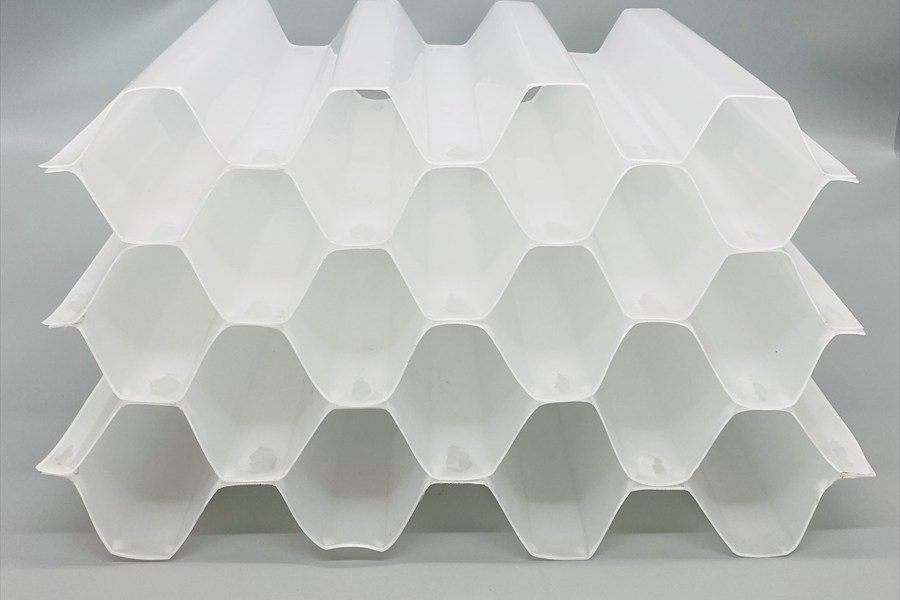
| Geometry | Tube settler: straight hexagonal tubes assembled into a honeycomb module. Lamella plate: corrugated or framed flat plate packs. |
| Installation angle | Tube settler: 60°. Plate: 45–60° typical, fixed by the basin design rather than by the product. |
| Pore / cell size | Tube settler Φ25–90 mm depending on material. Plate Φ35 / Φ50 / Φ80 mm. |
| Material | Tube settler: PP, FRP or custom stainless steel. Plate: polyethylene / polypropylene co-polymer (E-P co-polymer). |
| Wall / plate thickness | Tube settler sheets 0.5–0.8 mm. Plate 0.4 mm (Φ35), 0.5 mm (Φ50), 0.8 mm (Φ80). |
| Module size | Both 1000×500×1000 mm as standard; plate modules are also built to basin dimensions or customer drawing. |
| Service life | PP 3–4 years; E-P co-polymer 8–10 years in water. |
| Surface area / porosity | Published for our tube settler media at 62–236 m²/m³ and 93–97% porosity. Plate specification is confirmed per project — ask and we will state it rather than assume a comparable figure. |
Higher surface area per m³, so it is the natural choice when the tank footprint is fixed and you need maximum settling capacity. The closed hexagonal tubes also protect the flow inside each channel, which is more forgiving where the inlet is poorly baffled.
Fewer, larger channels, so less prone to blocking on fibrous or high-solids loads — and plate packs can be built to basin dimensions or a customer drawing, which helps awkward tank shapes.
Tube settler modules are installed at 60°. Lamella plate angle is typically 45–60° and is set by the basin design. On a retrofit, the angle you can achieve may decide the product for you.
Both are available beyond the basic grade: tube settler in PP, FRP and custom stainless steel; plate in E-P co-polymer with a published 8–10 year life in water versus 3–4 years for PP. In aggressive duty the material decision can matter more than the geometry.
Whichever you choose, the sizing logic does not change — which is why it is worth settling early.
| 1. Design flow | Peak hydraulic flow through the clarifier, in m³/h. Use peak, not daily average. |
| 2. Surface loading rate | For our tube settler media the published hydraulic load is 3–5 t/m²·h (equivalent to 3–5 m³/m²·h). Fast-settling mineral solids suit the high end. |
| 3. Settling area | A = Q ÷ SLR. A 100 m³/h flow at 4 m³/m²·h needs about 25 m². |
| 4. Media volume | Multiply the area by the stack height, normally 4–5 m, to get m³ — the unit both products are quoted in. |
| 5. Velocity check | Confirm the design velocity inside the channels against the published 2.5–3.0 mm/s figure. |
The full worked example is in the tube settler sizing and specification guide.
They are related but not the same. Both are inclined settling media that increase effective settling area. Tube settler media uses hexagonal tubes; lamella media uses flat plates. Suppliers sometimes use the terms loosely, so it is worth confirming which geometry a quotation actually covers.
For the products we publish, our tube settler media is specified at 62–236 m²/m³. Plate specification is confirmed per project, so we state it rather than assume a comparable figure — ask us and we will give you the number for your configuration.
It is not normal practice. The modules have to stack to a consistent height and the flow pattern across the tank has to be uniform, so a mixed installation tends to create short-circuiting rather than the best of both.
Smaller pores block sooner regardless of geometry. Tube settler modules at the larger end (Φ50–90 mm) and plate packs with larger channels both handle fibrous and high-solids loads better than small-pore options.
Price is On request for both, and it depends on material, pore or cell size, thickness, volume, export packing and destination. Because the two products have different material options, the comparison is only meaningful once both are specified for your duty.
Yes — retrofit is the most common use of both. Modules are cut to suit existing weirs, launders and sludge scrapers. Restraint from above matters in both cases because empty PP modules are light.
Send your water quality, treatment scale and target standard - we will confirm the right media, quantity and export packing.
Request a QuoteNo obligation - response within 24h (working days)