What to verify before you place an order, how to make two quotations actually comparable, and which mistakes cause most media problems after installation.

Media is one of the few purchases where two suppliers can describe the same product in ways that are not comparable. These five checks separate them.
"Φ25 mm MBBR media" tells you almost nothing. Ask for surface area, hole count, density, porosity, pieces per m³ and dosing range together — those six figures define the carrier. Size alone does not.
Virgin and recycled polymer are both used in this industry and they are not the same purchase. Ask which one the quotation is based on, in writing. On a product with a design life measured in years, this is not a detail.
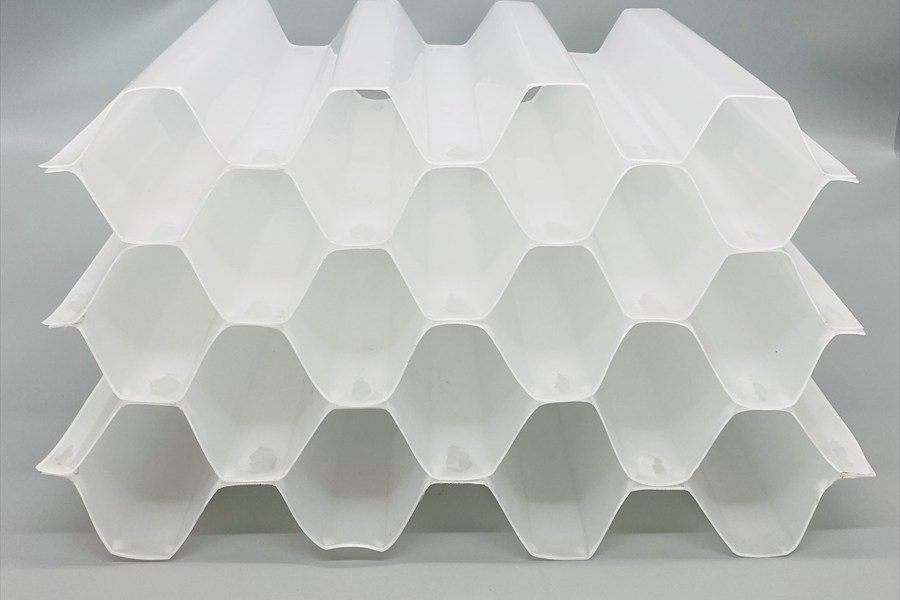
For inclined tube media, sheet thickness (typically 0.4–0.8 mm depending on pore size) and manufacturing tolerance affect both structural life and how the modules stack and fit in the tank.
If your project needs test reports or material certificates, raise it at the enquiry stage — not after the price is agreed. Some suppliers can provide them and some cannot; asking early avoids a late surprise.
Media is bulky and relatively light, so packing determines a large part of what you actually pay for. Ask specifically how it will be packed, and whether the packing suits your unloading arrangements.
Most "your price is higher" conversations turn out to be two suppliers quoting different scopes. Include these four in every enquiry.
| 1. Full specification | Not the product name — the parameters. For carriers: surface area, hole count, density, porosity. For tube media: pore size, material, sheet thickness, module size. |
| 2. Quantity, in the right unit | Carriers and media are quoted per m³; some products per metre or per piece. Confirm the unit before comparing totals. |
| 3. Delivery basis | Ex-works, FOB or CIF change the number substantially because media occupies container space rather than weight. State the destination port. |
| 4. Documentation and packing requirements | Certificates, test reports and specific export packing are all line items. If you need them, say so at the enquiry. |
The HS codes and import guide covers how plastic media is classified and what to send your customs broker.
A supplier based in China can often reduce your landed cost purely through paperwork — and if you do not ask, you will not get it.
Under the ASEAN–China Free Trade Area, a C/O Form E allows preferential duty rates into ASEAN markets. Ask whether it is included or costs extra, and confirm the exact consignee details it must carry.
If the goods move on within ASEAN before reaching you, Form D may be the relevant document. Check with your customs broker rather than assuming.
Plastic media falls under HS Chapter 39 (plastics and articles thereof); aeration and piping items may be classified differently. Classification is determined by your importing country's customs authority — confirm the code with your broker, and give them the material composition and product description so they can classify correctly.
Agree the Incoterm explicitly. Payment terms are confirmed with the quotation rather than published, because they depend on the order and the relationship.
These are the failures we see most often — and none of them are manufacturing defects.
The single most common cause of an undersized settler. The surface loading rate was applied to daily average rather than peak hydraulic load.
Small pores give more surface per m³ but blind faster on fibrous or oily loads. A carrier or tube specified purely on the biggest surface-area number can clog within weeks.
Empty PP modules are light. Without restraint from above, a drain-down or flow surge shifts them and creates short-circuiting at the tank wall.
PP suits general duty; FRP gives the highest surface area; stainless steel is for high temperature or aggressive chemistry. In industrial effluent this is a chemistry question, not a cost question.
Diffuser membranes foul and harden gradually, so efficiency drops long before anything fails. Plants that replace on schedule spend less on blower power than plants that wait for a visible problem.
Water treatment media and aeration equipment: tube settler and lamella media, MBBR biofilm carriers, suspended ball media, fiber ball filter media, disc aerators, and ABS pipework. See the product catalogue.
No. We manufacture media and aeration equipment and supply EPC contractors, distributors and plant operators. We are happy to work directly with your designer on the specification.
Yes. Send the specification or bill of quantities and we will confirm compliance item by item — or state plainly where our published figures differ from what is specified, rather than quietly substituting.
We quote against a destination port rather than operating a list of "supported countries". Tell us the port and we will confirm the logistics and the relevant trade documentation.
Send the duty, not just the product name: for sedimentation, the flow rate and solids type; for biological treatment, the load and target effluent; for aeration, the tank dimensions and oxygen requirement. We will confirm the specification against it.
Within 24 hours on working days, provided the enquiry includes the specification, quantity and destination. Enquiries missing those take longer because we have to come back and ask.
Send your water quality, treatment scale and target standard - we will confirm the right media, quantity and export packing.
Request a QuoteNo obligation - response within 24h (working days)